
Trustee vs Responsible Entity: Which One Does Your Fund Need?
The difference between a trustee and a responsible entity comes down to one question: does your scheme have to be registered with ASIC? A wholesale fund that stays unregistered is run by a trustee under a trust deed. A registered scheme, which is what you need once retail investors are involved, must be run by a responsible entity. The Corporations Act 2001 requires that responsible entity to be a public company holding an Australian financial services licence authorising it to operate a managed investment scheme. The trustee vs responsible entity choice depends on who you raise capital from.
That one-line answer hides a lot of operating consequence. The two roles carry different capital requirements, different reporting to ASIC, different board composition rules, and very different costs when you want to change provider. Here is what separates them.
What a trustee does in a wholesale fund
An unregistered scheme is a trust. The trustee holds fund assets for unitholders, and its powers and duties come from the trust deed and from trust law.
Licensing does apply. ASIC sets out that a trustee that issues, varies or disposes of interests in an unregistered scheme must in most cases hold an AFSL authorising it to deal in a financial product by issuing, varying or disposing of interests in a managed investment scheme.
What the trustee model looks like in practice:
- The trustee can be a proprietary company.
- There is no compliance plan to lodge with ASIC and no annual compliance plan audit.
- There is no compliance committee requirement.
- Internal dispute resolution and AFCA obligations attach to retail clients, so a wholesale-only fund sits outside them.
- The operating terms sit in a deed that you and your lawyers write.
For the role on its own, including who holds the assets, whether the trustee needs its own AFSL and how to choose between an in-house and an external trustee, see FundBase Group's guide to what a trustee is and whether you need one for your fund.
What a responsible entity does in a registered scheme
A responsible entity operates the scheme and holds scheme property on trust for members.
The responsible entry requirements: a public company holding an AFSL that authorises it to operate a managed investment scheme. ASIC ties the authorisation to the asset kind of the scheme, so a responsible entity licensed for one asset class cannot take on a scheme of a different kind without varying its licence.
A responsible entity must:
- act honestly
- exercise the degree of care and diligence a reasonable person would exercise in its position
- act in the best interests of members, and give members' interests priority where they conflict with its own
- treat members holding interests of the same class equally, and members holding different classes fairly
- ensure the scheme's constitution meets the requirements of the Act
- ensure the scheme's compliance plan meets the requirements of the Act
Those duties are owed to members and enforced by ASIC. They are the reason a responsible entity carries a different cost base from a wholesale trustee.
For the role on its own, including how a responsible entity is appointed, the NTA thresholds it has to meet and what changes from 1 July 2027, see FundBase Group's guide to what a Responsible Entity is and what it does.
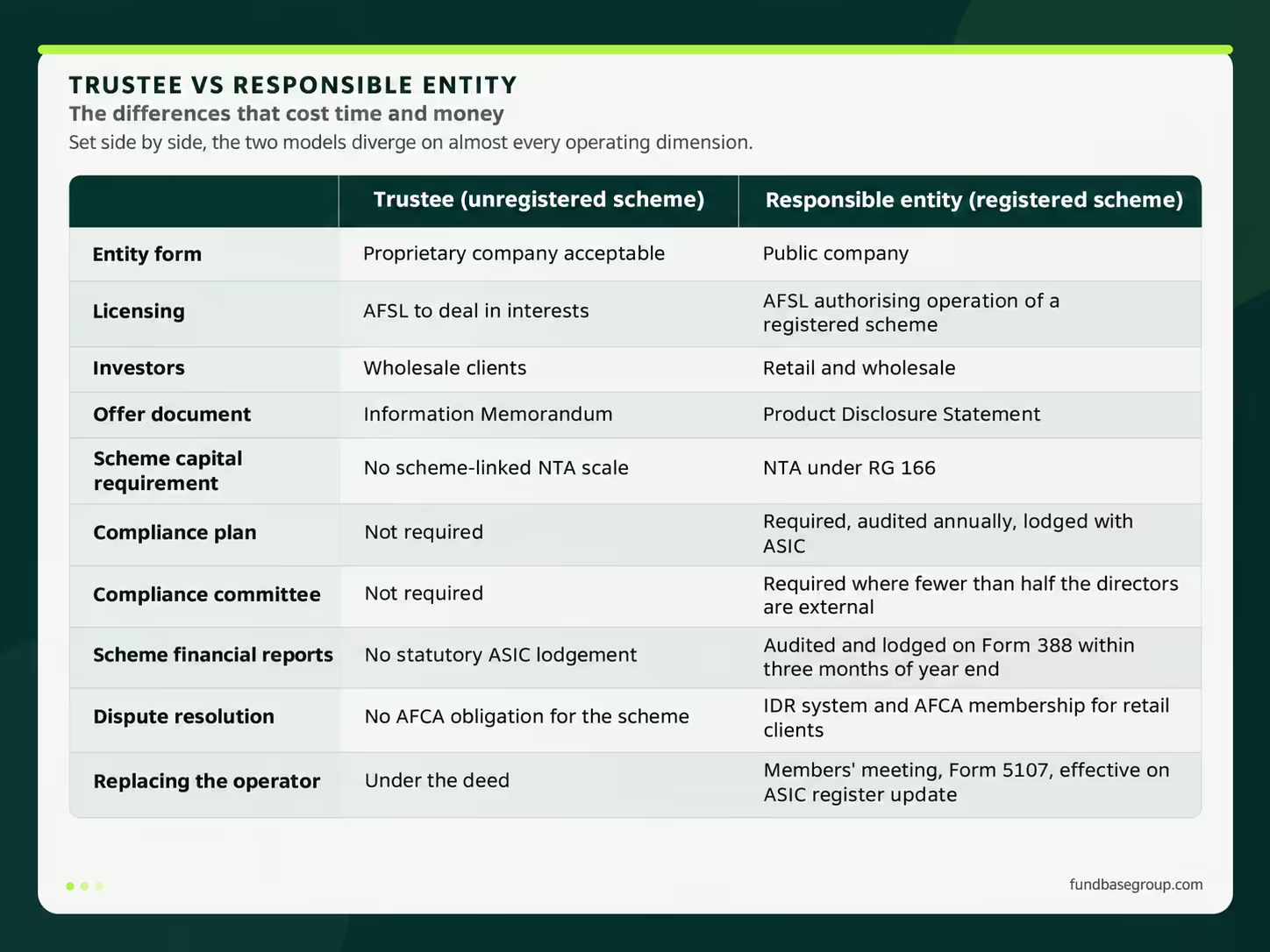
Trustee vs responsible entity: the differences that cost time and money
Set side by side, the two models diverge on almost every operating dimension.
Capital sitting behind the operator
A responsible entity has to meet a net tangible assets requirement under ASIC Corporations Instrument 2023/647 and Regulatory Guide 166. Where an approved custodian holds scheme property, the concessional NTA requirement is the greater of $150,000, 0.5% of the average value of scheme property capped at $5 million, or 10% of average revenue. Without that custodian arrangement the figure rises to $10 million. At least half the required NTA must be held in cash or cash equivalents.
Those thresholds are moving. ASIC announced in July 2026 that the minimum financial thresholds in the NTA requirement will be increased to reflect inflation between June 2013, when they were last updated, and March 2026, and that annual indexation will be introduced. The changes commence on 1 July 2027, and the thresholds applying from that date will include the first indexation adjustment. They reach responsible entities, IDPS operators and corporate directors of retail CCIVs.
A wholesale trustee carries no equivalent scheme-linked NTA scale, though its own AFSL brings financial requirements of its own.
The annual obligation load
A registered scheme generates a recurring lodgement calendar that a wholesale trust does not:
- The compliance plan must be audited within three months of the end of the scheme's financial year, with the audit report lodged on Form 5111.
- Any modification or replacement compliance plan must be lodged within 14 days and signed by every director of the responsible entity.
- Constitution changes must be lodged with ASIC.
- A financial report and directors' report must be prepared each financial year, audited, and lodged on Form 388 within three months of year end.
- A compliance committee is required where fewer than half the directors of the responsible entity are external directors, and it must be established within 14 days.
- Retail clients bring internal dispute resolution obligations and AFCA membership.
None of this is optional, and none of it scales down for a small fund. A $15 million registered scheme carries much the same calendar as a $500 million one.
Changing your mind later
This is where the asymmetry bites hardest, and it is the part most emerging managers price in too late.
Replacing a wholesale trustee is a deed-level exercise. Replacing a responsible entity is not. It runs through a members' meeting, with an extraordinary resolution where the scheme is unlisted. The outgoing responsible entity must notify ASIC within two business days of the resolutions passing. The change takes effect only when ASIC updates its registers, and it cannot be backdated.
Choosing a trustee is a decision you can revisit. Choosing a responsible entity is one you should expect to live with.
How FundBase Group supports both paths
FundBase Group (FB Corp Limited, AFSL 557810) provides wholesale fund trustee services aligned to a fund's structure and operating requirements, alongside the functions that sit around them. If your fund needs to be registered and run by a responsible entity, FundBase Group can engage a partner to help you find and appoint a suitable responsible entity.
AFSL coverage for wholesale funds. For managers who would rather not apply for and maintain their own AFSL, FundBase Group provides AFSL coverage under a Corporate Authorised Representative arrangement, with training and supervision attached.
Investor onboarding and registry. Digital onboarding, KYC and AML/CTF support and ongoing investor administration run through the FundBase technology platform.
Fund administration, accounting and reporting. Back-office fund administration and accounting support, with coordination of required tax and regulatory reporting and lodgement.
Weeks, not months. FundBase Group's model is built around getting managers operational quickly without compromising the obligations that come with running a fund.
If you are working out whether your next fund needs a trustee or a responsible entity, contact the FundBase Group team to talk through your structure, your timeline and the level of support required.
References
- ASIC Corporations (Financial Requirements for Responsible Entities, IDPS Operators and Corporate Directors of Retail CCIVs) Instrument 2023/647 (Cth). https://www.legislation.gov.au/F2023L01162/asmade/text
- Australian Securities and Investments Commission. Running a registered scheme. https://www.asic.gov.au/for-finance-professionals/fund-operators/running-a-registered-scheme
- Australian Securities and Investments Commission. ASIC announces changes to net tangible assets requirement for responsible entities. https://www.asic.gov.au/about-asic/news-centre/news-items/asic-announces-changes-to-net-tangible-assets-requirement-for-responsible-entities
- Australian Securities and Investments Commission. AFS licensing requirement for trustees of unregistered managed investment schemes (Information Sheet 251). https://www.asic.gov.au/for-finance-professionals/afs-licensees/applying-for-and-managing-an-afs-licence/licensing-certain-service-providers/afs-licensing-requirement-for-trustees-of-unregistered-managed-investment-schemes
- Australian Securities and Investments Commission. How to register a managed investment scheme. https://www.asic.gov.au/for-finance-professionals/fund-operators/how-to-register-a-managed-investment-scheme/
- Australian Securities and Investments Commission. Registered managed investment schemes. https://www.asic.gov.au/regulatory-resources/managed-funds/managed-investment-schemes/registered-managed-investment-schemes/
- Corporations Act 2001 (Cth) s 601ED. https://www.austlii.edu.au/au/legis/cth/consol_act/ca2001172/s601ed.html
- Corporations Act 2001 (Cth) s 601FA. https://classic.austlii.edu.au/au/legis/cth/consol_act/ca2001172/s601fa.html
- Corporations Act 2001 (Cth) s 601JA. https://www.austlii.edu.au/cgi-bin/viewdoc/au/legis/cth/consol_act/ca2001172/s601ja.html
- Gilbert + Tobin. ASIC consults on increasing NTA requirements for responsible entities and other fund operators. https://www.gtlaw.com.au/insights/key-topics/regulation-in-motion/asic-consults-on-increasing-nta-requirements-for-responsible-entities-and-other-fund-operators


Ready to launch
Get in touch with our team to discuss your fund management needs.