

Starting a hedge fund in Australia requires three things: a legal fund structure (typically a unit trust operating as a managed investment scheme), an Australian Financial Services Licence (AFSL) or coverage under one, and a set of fund services — administration, investor registry, and compliance — to keep the fund running once it is live. This guide covers each step in sequence.
What ASIC Means by “Hedge Fund”
ASIC does not have a single statutory definition of “hedge fund.” Instead, it regulates these retail products under Regulatory Guide 240 (RG 240), which applies to funds using complex strategies — borrowed capital, short selling, derivatives, or concentrated positions. In practice, most Australian hedge funds are established as unit trusts and fall within the definition of a managed investment scheme (MIS) under the Corporations Act 2001.
An MIS is any arrangement where investors pool their money, contributions are managed by someone other than the investors themselves, and investors stand to share in returns. A hedge fund with pooled capital, a named manager, and a defined investment strategy meets this description.
The Decision That Shapes Everything: Wholesale vs Retail
The most consequential choice when starting a hedge fund in Australia is deciding who your investors will be.
Wholesale funds accept only wholesale clients — those meeting thresholds under the Corporations Act 2001 (net assets above $2.5 million, gross income over $250,000 in each of the prior two financial years, or those qualifying as professional investors). This is the most common starting point for emerging managers.
Retail funds can accept any investor but carry substantially heavier obligations. Once you offer interests to retail clients, the scheme must be registered with ASIC, operated by a Responsible Entity (RE) holding the relevant AFSL, appointed custodian and accompanied by a PDS that meets the content requirements of the Corporations Act. ASIC’s RG 240 sets enhanced disclosure requirements for retail hedge funds — covering strategy, liquidity terms, borrowed capital usage, counterparties, valuation methodology, and stress testing.
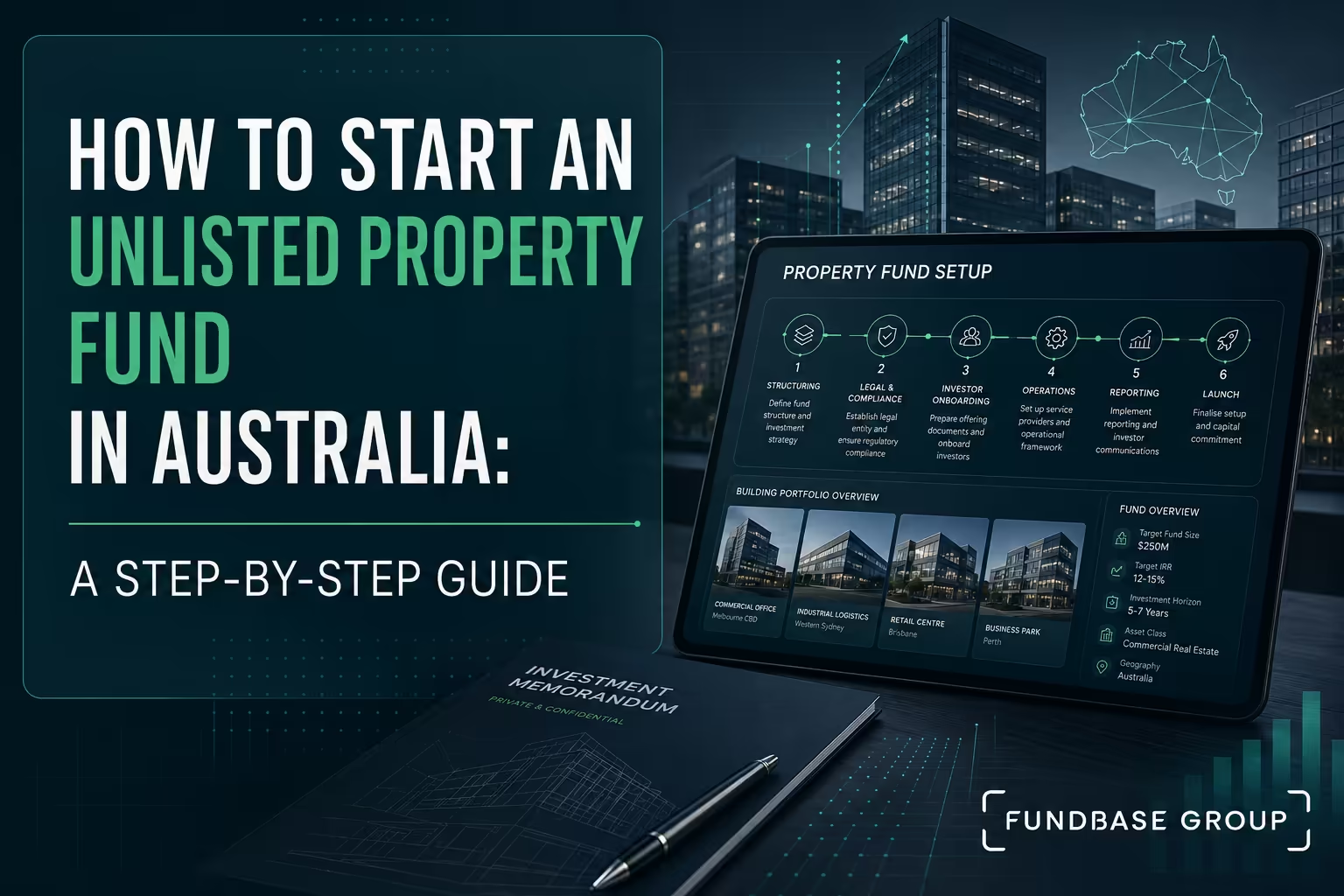
How to Start a Hedge Fund in Australia: Step by Step
1. Choose Your Fund Structure
Most Australian hedge funds are established as unit trusts — well understood by local institutional investors, and suited to strategies across equities, fixed income, credit, macro, and alternatives. Corporate Collective Investment Vehicles (CCIVs), introduced in 2022, are an additional option, but unit trusts remain the standard choice.
Decisions to lock in at this stage:
- Wholesale or retail investor base
- Fee structure: management fee, performance fee, and hurdle rate
- Liquidity terms: daily, monthly, or quarterly redemptions
- Australian domicile or offshore
2. Secure AFSL Coverage
Every fund operator in Australia must either hold an AFSL or operate as a Corporate Authorised Representative (CAR) under an existing AFSL holder. Obtaining your own AFSL is time-consuming. ASIC requires evidence of responsible managers with relevant qualifications, an organisational structure that demonstrates competence, adequate financial resources, and a documented compliance framework.
For emerging managers, operating under a CAR arrangement is the more practical path to market. A CAR arrangement gives the manager coverage for dealing, advising, and operating an MIS under the licence holder’s AFSL. The manager can then focus on the investment function from day one.
3. Appoint a Responsible Entity or Trustee
For wholesale funds, a corporate trustee holds legal title to fund assets and issues interests to investors. The trustee either holds an AFSL or operates under an authorised representative arrangement. Contractual documentation — in particular, the investment management agreement between trustee and manager — must be precise about who holds which authorisations.
For retail (registered) schemes, the Responsible Entity is the single legal operator of the fund. The RE owes statutory duties to act in members’ best interests, must be an Australian public company, must hold an AFSL with the RE authorisation, and must have governance arrangements that meet the Corporations Act requirements. Many emerging managers engage an external, professional RE — this lets a fund reach the market without first building a compliant RE structure from the ground up.
4. Register the Scheme with ASIC (Retail Funds Only)
Retail managed investment schemes must be registered with ASIC before interests are offered to retail investors. The application must show that:
- The RE holds an AFSL authorising it to operate the scheme
- The RE is an Australian public company
- The fund has a constitution and compliance plan meeting the Corporations Act requirements
- A compliance plan auditor has been appointed
Once ASIC receives a complete application, it must make a decision within 14 days. Successful registration gives the scheme an Australian Registered Scheme Number (ARSN).
Wholesale funds do not require ASIC scheme registration.
5. Prepare Your Fund Documents
At a minimum, you will need:
- A trust deed or fund constitution
- An investment management agreement (IMA) between the trustee/RE and the investment manager
- An Information Memorandum (wholesale) or Product Disclosure Statement (retail)
- A compliance plan (required for registered schemes)
- Subscription agreements and investor application forms
For retail hedge funds, the PDS must meet the content requirements of the Corporations Act and ASIC’s RG 240 enhanced disclosure requirements — covering strategy, risks, use of borrowed capital, liquidity terms, counterparties, valuation procedures, and stress testing.
6. Enrol with AUSTRAC
Funds that provide designated financial services must enrol with AUSTRAC and put an Anti-Money Laundering and Counter-Terrorism Financing (AML/CTF) program in place. This covers:
- Customer due diligence at investor application
- Ongoing monitoring of investor activity
- Record-keeping obligations
- Reporting of suspicious matters
This is a live, ongoing obligation. Your investor application workflows must be built with these requirements from the outset — not added after the fact.
7. Put Your Fund Services in Place
A fund cannot run on the investment strategy alone. Before accepting the first application, you will need:
- Fund administration and accounting: NAV calculation, unit pricing, and transaction processing
- Investor registry: tracking unit holdings, processing applications and redemptions, investor communications
- Reporting: investor statements, fund performance reports, regulatory and tax lodgements
- Audit support (if applicable): financial statement preparation and coordination with the scheme auditor
- Custody: an independent custodian, or incidental custody as part of a broader service arrangement
Each of these can be sourced from separate providers or as part of a single, coordinated arrangement. The choice has direct implications for consistency, cost, and investor experience.
How Long Does It Take to Launch?
A wholesale fund using an external trustee and CAR arrangement can realistically reach its first investor close in four to six weeks, provided documentation is prepared in parallel with the licensing and service setup. Retail-registered schemes take longer — three to six months or more — due to ASIC registration requirements, PDS preparation, and the compliance framework required for an RE.
The most common sources of delay are incomplete documentation, errors in fund structure decisions that require rework, and gaps between service providers that no one fully owns. Every gap in the setup process adds time.
One Operating Partner vs Many: The Coordination Question
Pulling together the elements described above — AFSL coverage, trustee or RE services, documentation, investor administration, fund accounting, and regulatory reporting — means managing multiple specialists. Many emerging managers end up with a fund administrator in one place, a registry provider elsewhere, a compliance consultant on retainer, and a technology platform added separately. Each provider knows their own slice; no one takes responsibility for the whole.
FundBase Group was built to address this directly. Rather than managing a chain of separate providers, FundBase provides a single operating partner across the full set of fund functions:
- Fund formation and structuring support, including documentation designed for launch
- AFSL coverage via CAR arrangement, with training and ongoing supervision — so managers without their own AFSL can reach the market without waiting for a licence approval
- Trustee services
- Digital investor application and registry, with KYC/KYB and AML/CTF processes built in from day one
- Fund administration and accounting, including NAV calculation and unit pricing
- Regulatory and tax reporting, managed and lodged as part of the service
The model matters for timing. When formation, licensing, investor administration, and fund accounting are handled by one team, the process moves faster — there are no handoffs between providers, and no gaps in accountability. FundBase Group’s Fund-in-a-Box brings all of this together under one coordinated arrangement, designed for managers who want to reach the market without cutting corners on compliance or investor experience.
Ready to Launch Your Hedge Fund?
If you’re at the planning stage — or already working through the steps above — FundBase Group can walk you through your fund structure, timeline, and service requirements in a first conversation. Contact the team to discuss your hedge fund and what it will take to launch.
REFERENCES
1. Australian Securities and Investments Commission. How to register a managed investment scheme. https://www.asic.gov.au/for-finance-professionals/fund-operators/how-to-register-a-managed-investment-scheme/
2. Australian Securities and Investments Commission. RG 240 Hedge funds: Improving disclosure. https://www.asic.gov.au/regulatory-resources/find-a-document/regulatory-guides/rg-240-hedge-funds-improving-disclosure/
3. Sprintlaw. Launching a hedge fund: Essential Australian legal and compliance guide. https://sprintlaw.com.au/articles/launching-a-hedge-fund-essential-australian-legal-compliance-guide/
4. Chambers and Partners. Investment funds 2025: Australia. Global Practice Guides. https://practiceguides.chambers.com/practice-guides/investment-funds-2025/australia/trends-and-developments
5. Australian Securities and Investments Commission. Regulatory Guide 131: Funds management — Establishing and registering a fund. https://www.asic.gov.au/regulatory-resources/find-a-document/regulatory-guides/rg-131-funds-management-establishing-and-registering-a-fund/


Ready to launch
Get in touch with our team to discuss your fund management needs.