
Before a single dollar is raised, every fund manager in Australia must resolve the same compliance question: what licensing structure will govern the business?
Two paths exist. You can apply directly to ASIC for your own Australian Financial Services Licence (AFSL). Or you can operate as a Corporate Authorised Representative (CAR) under an existing AFSL holder's licence. The choice shapes your timeline, your compliance obligations, your cost structure, and how quickly you can put capital to work.
This article explains what each path requires, how they differ in practice, and how to think through the decision given where your fund sits today.
What Is an Australian Financial Services Licence?
An AFSL is a legal authorisation issued by ASIC under Chapter 7 of the Corporations Act 2001 (Cth). Holding one permits you to carry on a financial services business in Australia - potentially including providing financial product advice, dealing in financial products, and operating managed investment schemes.
Every fund that accepts external capital needs AFSL coverage, either through holding a licence or through an authorised representative arrangement. There is no middle ground. The penalties for operating without proper coverage are severe, including criminal liability.
ASIC had 6,349 AFSLs active at the end of FY2024, up from 3,853 at the end of FY2004 — a 65% increase over two decades. In the 2023–24 financial year alone, ASIC granted 280 new AFSLs.
What an AFSL requires
To obtain an AFSL, a manager must demonstrate to ASIC that they:
- Are competent to provide the financial services specified in the application, through Responsible Managers who meet ASIC's experience and qualification requirements
- Have adequate financial resources to support the business and meet ongoing requirements
- Have compliance systems in place — including documented procedures for risk management, conflicts of interest, training and dispute resolution and more
- Are fit and proper persons — covering directors, secretaries, senior managers and controlling shareholders
Once licensed, the AFSL holder becomes directly responsible to ASIC for meeting all ongoing obligations. These obligations do not diminish over time; they grow as the fund's activities expand.
What it costs and how long it takes
The direct ASIC registration fee ranges between $2,000 and $10,000, depending on whether it is a simple application or a high-complexity retail authorisation. Total establishment costs — including legal advice, compliance preparation, and supporting documents — can range from $25,000 to $50,000 or more, depending on the provider and the complexity.
Once the application is lodged, ASIC targets a decision on 70% of applications within 150 days and 90% within 240 days, as published in its Service Charter.
In practice, managers regularly report timelines of three to eighteen months, with more complex structures taking longer and depending on how you partner with to help you lodge.
Ongoing annual costs include compliance ($8,000–$25,000+), annual audits (typically around $10,000 and more), the ASIC industry funding levy and AFCA membership (for retail authorisations).
What Is a Corporate Authorised Representative?
A Corporate Authorised Representative (CAR) is an entity appointed by an AFSL holder to provide financial services on the licensee's behalf. The CAR operates under the AFSL holder's licence rather than holding its own.
Under this arrangement, the AFSL holder supervises the CAR's financial services activities. The CAR must operate within the AFSL holder's compliance frameworks, supervision structures, and authorised scope.
For fund managers — particularly those launching for the first time — this model is generally faster and less capital-intensive to establish than applying for an independent AFSL.
What operating as a CAR requires
A CAR must:
- Be formally appointed by an AFSL holder through a written CAR agreement setting out the scope of authorised activities
- Comply with the AFSL holder's compliance systems and supervision requirements as a condition of the appointment
- Maintain adequate training and competence across the team providing financial services
- Hold appropriate insurance coverage as specified in the CAR agreement
- Report to the AFSL holder on compliance matters and activities — the AFSL holder then reports to ASIC
The CAR does not need to build its own compliance framework from scratch. It adopts the AFSL holder's existing procedures and operates within those boundaries.
The quality of the AFSL holder matters
A CAR arrangement is only as strong as the AFSL holder supervising it. In 2024, the Federal Court found that Lanterne Fund Services had failed in its obligations to properly supervise its CARs — a case that reinforced ASIC's expectations around oversight, due diligence and ongoing monitoring of CAR arrangements. Managers should assess the governance quality of any AFSL holder they consider working with, not just the speed or cost of the arrangement.
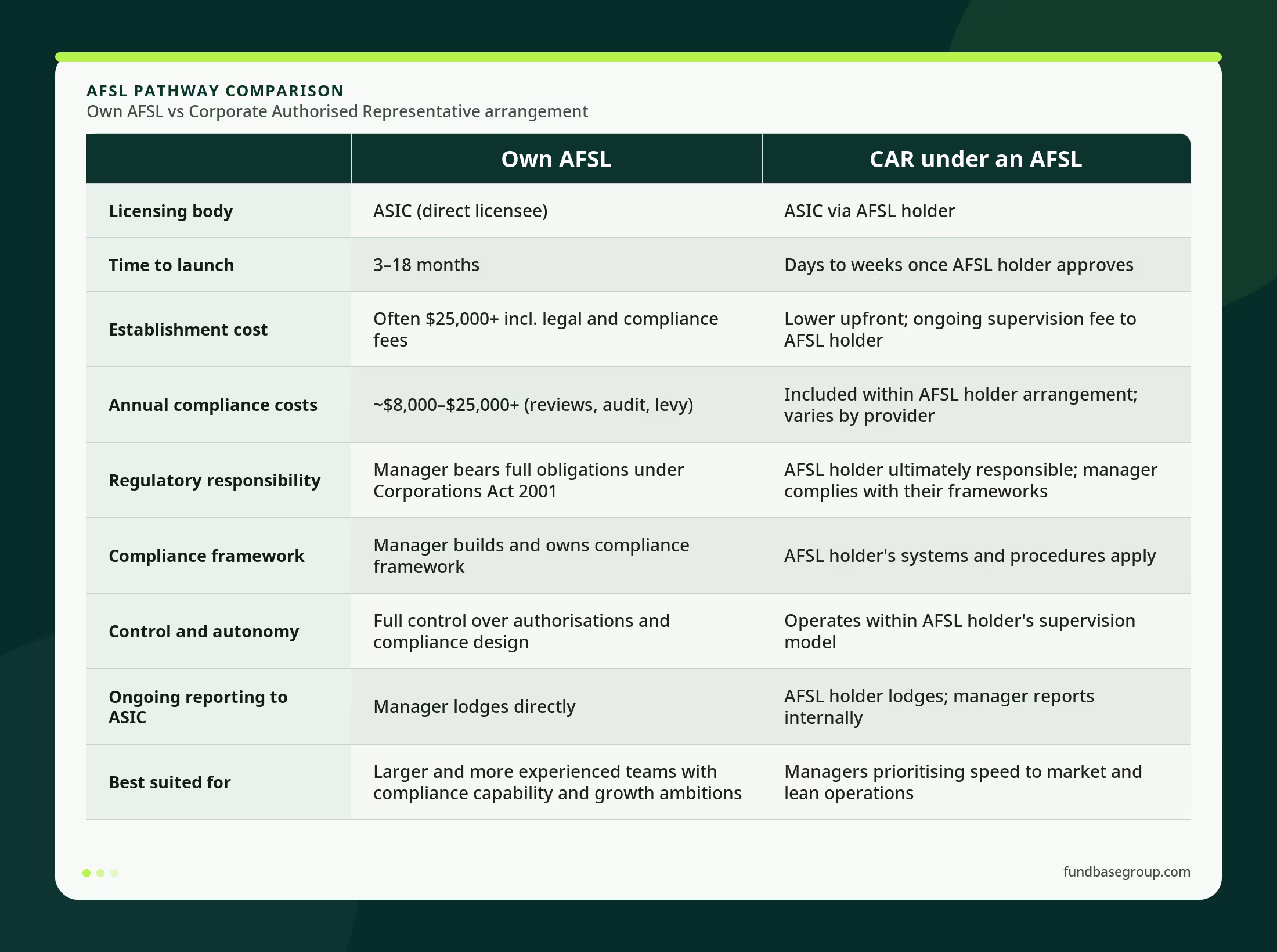
AFSL vs CAR: A Practical Comparison
Which Path Is Right for Your Fund?
There is no single answer that applies to every manager. The right path depends on where your fund is today and where it needs to go.
The CAR path tends to suit managers who:
- Are launching for the first time and prioritise speed to market
- Don’t meet ASIC’s minimum experience, qualification and capability requirements
- Want to focus operational resources on investment management, not compliance infrastructure
- Are working within limited budgets in the early stages of fund formation
- Are building track record before transitioning to a direct AFSL — a path described in detail in our Practical Guide to Launching an Investment Fund in Australia
The direct AFSL path tends to suit managers who:
- Have experienced compliance professionals in-house or are prepared to invest in them
- Are scaling to institutional-grade operations where independent regulatory standing matters to investors
- Want full control over the compliance framework design and do not want to operate within another party's framework
- Are seeking long-term autonomy and the ability to authorise their own representatives as the business grows
Many managers begin as a CAR and build toward their own AFSL over time, once AUM and internal capability justify it. This staged approach is practical, well-precedented and widely used across the Australian funds management industry.
What Has Changed with AFSL Applications in 2025?
From 16 June 2025, ASIC migrated all AFSL transactions — new applications, variations and cancellations — to the ASIC Regulatory Portal. Legacy eLicensing forms (FS01, FS03) are no longer accepted.
The updated system removes the previous requirement to submit separate 'core' and 'non-core' proof documents. Applications are now submitted as integrated online transactions. People Proofs for Responsible Managers are uploaded through the portal, with ASIC pre-filling known information where available.
These changes do not reduce the substance of what ASIC requires. They change the channel. The standards for Responsible Managers, compliance systems and fit-and-proper persons remain fully in force.
How FundBase Group Supports Both Paths
FundBase Group holds its own AFSL (FB Corp Limited AFSL 557810) and offers CAR coverage to fund managers as part of its service suite. Rather than requiring managers to secure their own AFSL before launch, FundBase provides an established compliance framework, training and supervision — enabling managers to operate as a CAR under FundBase's licence while their fund establishes its track record and operational foundation.
This is one component of a broader operating model. FundBase Group's services also cover fund formation and structuring, trustee and Responsible Entity services, investor onboarding and registry, fund administration, and reporting and compliance support.
Managers who want to engage across all these functions from a single operating partner can do so through the Fund-in-a-Box solution — a coordinated delivery model designed to reduce the complexity of launching and running a fund. Those who need specific services to complement existing arrangements can engage through Fund Services on a modular basis. Managers at particular stages of the fund lifecycle — whether launching, transitioning providers or scaling — can find tailored support through Solutions.
This matters because the licensing path you choose affects more than just the licence. It determines how quickly you can reach investors, what your compliance costs look like in year one, and how much operational overhead you carry from day one. Getting that decision right — with the right operational partner in place — is part of building a fund that lasts.
Questions to Ask Before Deciding
These five questions will help you land on the right path for your situation:
- What is your timeline? If you need to be in market within weeks, the CAR path is almost certainly more appropriate.
- Do you have compliance infrastructure in-house? Without a qualified Responsible Manager, clearly defined compliance framework and documented systems, an AFSL application may stall.
- What is your operational budget in year one? AFSL establishment and ongoing compliance costs are material and need to be planned for.
- What is your five-year plan? If you intend to scale to institutional-grade operations, plan the path to a direct AFSL from day one — even if you start as a CAR.
In summary: The CAR path offers speed and lower upfront cost. The direct AFSL path offers independence and full control. Most early-stage managers start with a CAR arrangement and build toward their own licence as the fund matures. The quality of the AFSL holder you partner with — including their compliance framework, oversight model and institutional standing — determines how well the CAR path serves you.
References
Australian Securities and Investments Commission. REP 797 Licensing and professional registration activities: 2024 update. ASIC. https://asic.gov.au/regulatory-resources/find-a-document/reports/rep-797-licensing-and-professional-registration-activities-2024-update/
AFSL House. How long will your AFS licence application process take? https://afslhouse.com.au/insights/afs-licence-application-timeline/
Australian Securities and Investments Commission. AFS licensees. https://www.asic.gov.au/for-finance-professionals/afs-licensees/
Hall & Wilcox. AFS licence application – steps and timing. https://hallandwilcox.com.au/news/afs-licence-application-steps-and-timing/
Money Management. ASIC looks to simplify AFSL application process. https://www.moneymanagement.com.au/asic-looks-simplify-afsl-application-process
AFSL House. AFSL update June 2025: What your business needs to know. https://afslhouse.com.au/insights/16-june-2025-updates-to-afsl-application-process/
Money Management. Is ASIC in a 'cold war' against self-licensing? https://www.moneymanagement.com.au/news/financial-planning/asic-cold-war-against-self-licensing
Finance Magnates. Australia has 280 new AFS license holders. https://www.financemagnates.com/forex/australia-has-280-new-afs-license-holders-how-many-of-them-are-cfds-brokers/
Allens. Federal Court and ASIC shine spotlight on supervisory and risk management requirements for CAR arrangements. https://www.allens.com.au/insights-news/insights/2024/04/federal-court-and-asic-shine-spotlight-on-supervisory-and-risk-management-requirements-for-car-arrangements/
Chambers and Partners. Alternative funds 2024: Australia. https://practiceguides.chambers.com/practice-guides/alternative-funds-2024/australia

Ready to launch
Get in touch with our team to discuss your fund management needs.