
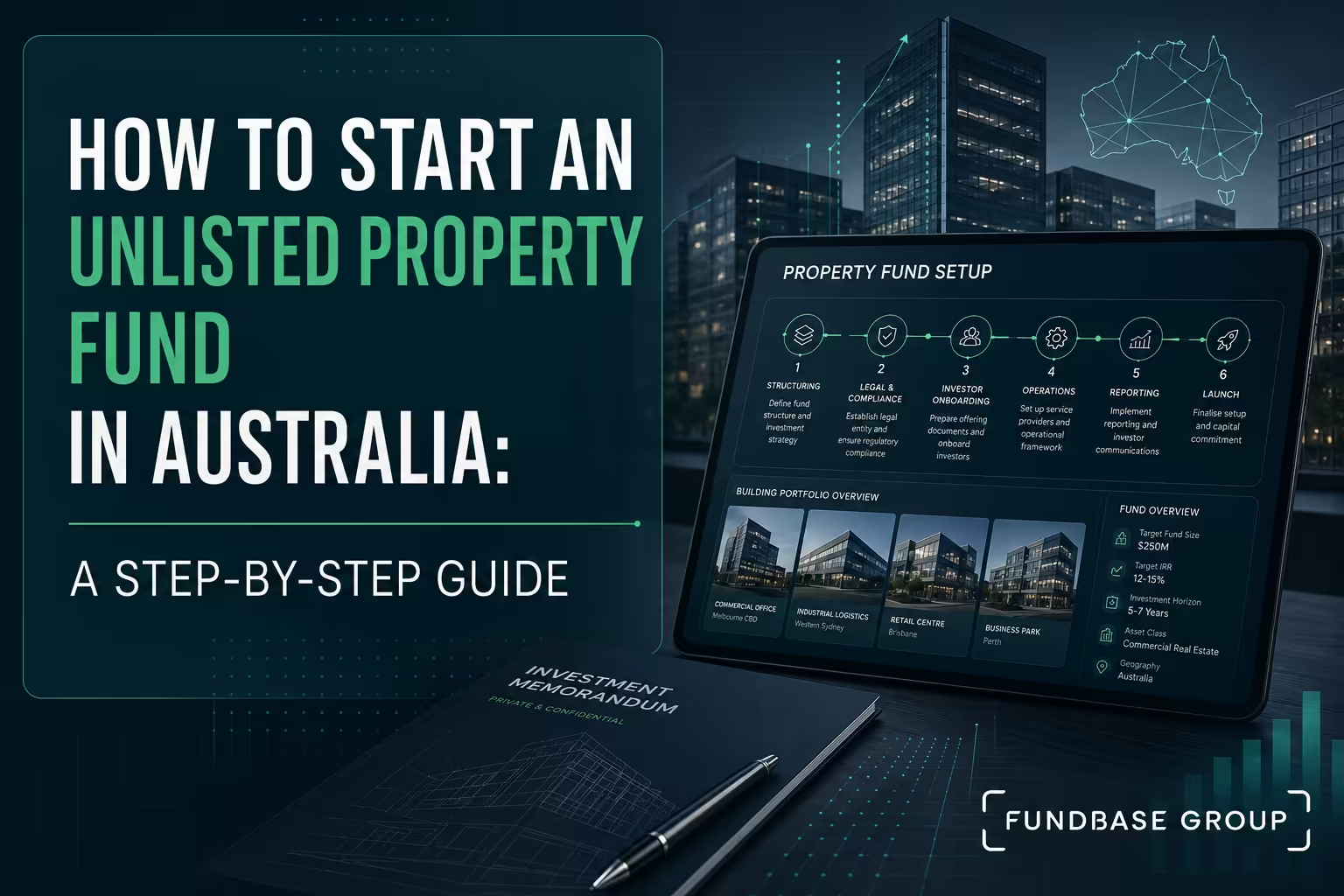
Starting an unlisted property fund in Australia means pooling capital from investors into a managed investment scheme that holds real property assets — without listing on the Australian Securities Exchange. To do it lawfully, you need the right fund structure, an Australian Financial Services Licence (AFSL) or coverage under one, and in most cases, a Responsible Entity or Trustee to operate the scheme. With the right operational support in place, the process can be completed in a matter of weeks.
This guide covers the regulatory requirements, structural options, and practical steps involved in getting an unlisted property fund off the ground in Australia.
What Is an Unlisted Property Fund?
An unlisted property fund is an investment vehicle that allows multiple investors to pool money into commercial or residential real estate assets. Unlike listed real estate investment trusts (REITs), these funds are not traded on the ASX. They are typically structured as unit trusts and operate as managed investment schemes (MIS) under the Corporations Act 2001.
Because investors are not in control of day-to-day operations, and because their contributions are pooled to generate a financial benefit, these funds fall within ASIC's definition of a managed investment scheme. That classification shapes which regulatory obligations apply to you as the fund manager.
Registered vs Unregistered: Which Does Your Fund Need?
Wholesale-Only (Unregistered) Funds
If all investors in the fund qualify as wholesale clients, registration is not required. An individual qualifies as a wholesale investor under one of the following tests:
- Assets test: Net assets of at least $2.5 million, confirmed by a qualified accountant's certificate
- Income test: Gross income of at least $250,000 per year in each of the last two financial years, confirmed by a qualified accountant's certificate
- Product value test: A single investment of $500,000 or more in the fund
- RG 46 compliance for retail property funds: ASIC Regulatory Guide 46 (RG 46) sets specific disclosure requirements covering liquidity, valuations, and related-party transactions
However, even an unregistered fund requires an AFSL. Under ASIC's Information Sheet 251, a trustee of an unregistered scheme that issues, varies, or disposes of interests in that scheme must generally hold an AFSL, or operate as an authorised representative (AR) under an existing AFSL holder.
Registered Schemes (Including Retail Investors)
If your property fund will accept retail investors, it must be registered with ASIC. A registered scheme requires:
- Responsible Entity (RE): An Australian public company holding an AFSL authorising it to operate the scheme
- Constitution and compliance plan: Both must be lodged with ASIC before the scheme begins operating
- RG 45 compliance for retail property funds: ASIC Regulatory Guide 45 sets specific disclosure requirements covering liquidity, valuations, and related-party transactions
Choosing the Right Structure for Your Unlisted Property Fund
Most unlisted property funds in Australia use a unit trust structure. Investors hold units, a manager makes investment decisions, and a trustee or Responsible Entity holds the assets on their behalf. The three most common paths are:
- Wholesale Unit Trust (Unregistered MIS): Lower regulatory burden, faster to set up. Suitable for managers raising capital from wholesale or institutional investors. An AFSL or CAR arrangement is still required.
- Registered MIS with Responsible Entity: Required when accepting retail investors. Heavier compliance obligations, but opens the fund to a broader investor base. The RE carries statutory duties, including acting in investors' best interests and lodging annual financial reports with ASIC.
- Special Purpose Vehicle (SPV): Often used for single-asset or co-investment transactions. Less ongoing compliance burden, but limited investor scalability.
How to Start an Unlisted Property Fund in Australia: Step by Step
Step 1: Define your investment strategy and investor base
What assets will the fund hold — commercial property, residential development, industrial, or a mixed portfolio? Who will invest — wholesale or retail? The answers to these questions dictate the legal structure and the regulatory path you take.
Step 2: Choose your legal structure
Based on investor type and expected fund size, decide between an unregistered wholesale trust and a registered managed investment scheme. Get advice from a lawyer who specialises in funds management or AFSL law at this stage — getting the structure wrong upfront is expensive to reverse.
Step 3: Secure an AFSL or authorised representative (CAR) coverage
To issue interests in any MIS, you need an AFSL or must operate under an existing licensee as a Corporate Authorised Representative (CAR). Applying for a new AFSL is a detailed process that typically takes some months from lodgement to approval. Operating as an AR under an existing AFSL — sometimes called incubation — is considerably faster and is the path most emerging managers take.
Under FundBase Group's model, managers operate as authorised representatives under FundBase's own AFSL, which removes the need to apply for a standalone licence and can cut months from the launch timeline.
Step 4: Appoint a Responsible Entity or Trustee
For a registered MIS, the Responsible Entity must be an Australian public company with the appropriate AFSL authorisations. For an unregistered scheme, a trustee takes this role. Both carry legal obligations to act in investors' interests, maintain compliance programs, and report to ASIC. Many emerging managers appoint an external RE or Trustee rather than building this capability in-house.
Step 5: Prepare your fund documentation
A property fund requires, at a minimum:
- Fund constitution or trust deed
- Information memorandum (wholesale) or Product Disclosure Statement (retail schemes)
- Compliance plan (registered schemes only)
- Anti-Money Laundering / Counter-Terrorism Financing (AML/CTF) program
- Application forms and investor agreements
For retail funds, ASIC's RG 46 governs what must be disclosed about liquidity, any borrowed funds within the scheme, valuations, and related-party dealings. These disclosures are not optional — they are a condition of the scheme's registration.
Step 6: Set up fund administration and operations
This covers net asset value (NAV) calculation, unit pricing, investor registry, fund accounting, tax reporting, audit support, and regulatory lodgements. Many emerging managers outsource this entirely rather than building a back office from scratch — it is often cheaper and faster, and it removes the risk of operational gaps in the early stages of the fund's life.
Step 7: Onboard investors
Digital investor onboarding has become the norm. A well-designed process includes digital application forms, automated KYC/AML checks, confirmation of wholesale investor status where applicable, and a secure investor portal for ongoing reporting and document access.
What Does It Actually Cost to Run an Unlisted Property Fund?
Setup costs vary widely depending on fund type. As a planning guide, budget for:
- Legal fees for fund documentation and fund structuring advice
- AFSL application costs (if applying directly) or authorised representative fees under an existing licence holder
- Trustee or Responsible Entity appointment fees
- Custody fees
- Fund administration, accounting, and registry fees
- Investor portal and technology costs
- Annual audit and ongoing compliance costs
For managers launching under an existing AFSL via a CAR arrangement, upfront licensing costs are typically lower. The trade-off is an ongoing service fee to the AFSL holder. For most emerging managers — particularly those launching a first fund — this remains the more cost-effective path to operate.
Common Mistakes When Setting Up an Unlisted Property Fund
Getting the structure wrong at the start is expensive to fix later. Here are the most common issues:
Raising capital before the structure is in place
Any offer of interests in an MIS without an AFSL — or a valid exemption — is a breach of the Corporations Act. ASIC takes this seriously, and non-compliance can result in enforcement action. Document the structure and secure your AFSL coverage before approaching investors.
Assuming a wholesale fund needs no compliance
An unregistered MIS still requires an AFSL, an AML/CTF program, proper fund documentation, and — depending on investor agreements — audited accounts. "Wholesale" does not mean unregulated.
Underestimating ongoing operational requirements
NAV calculation, tax reporting, investor registry management, and annual audits are not optional extras. Managers who treat them as secondary often run into compliance and investor relationship problems as the fund grows.
Working with multiple uncoordinated service providers
Using a lawyer for documents, a separate administrator, and a separate Trustee creates handoff risk, delays, and added cost. Each transition between providers is a point where things can fall through. A single operating partner across all functions removes that risk and tends to produce a faster, cleaner launch.
Setting Up an Unlisted Property Fund with FundBase Group
FundBase Group provides the operating infrastructure fund managers need to launch and run an unlisted property fund in Australia — from formation through to ongoing operations — under one roof.
Rather than working across multiple providers, managers engage one partner for:
- Fund formation and structuring support
- AFSL coverage under a CAR arrangement
- Trustee services
- Digital investor onboarding, KYC and AML/CTF
- Fund administration and accounting
- Regulatory reporting and governance support
This model is designed to get managers to market faster — in weeks rather than months — while maintaining the compliance standards that investors and regulators expect. FundBase Group supports a range of property fund structures.
Ready to launch an unlisted property fund? Speak with the FundBase Group team to discuss your fund structure, investor base, and timeline. Visit fundbasegroup.com/fund-in-a-box or contact us at fundbasegroup.com/contact.
References
- Australian Securities and Investments Commission. How to register a managed investment scheme. Australian Government. https://www.asic.gov.au/for-finance-professionals/fund-operators/how-to-register-a-managed-investment-scheme/
- Australian Securities and Investments Commission. Unregistered schemes. Australian Government. https://www.asic.gov.au/regulatory-resources/managed-funds/managed-investment-schemes/unregistered-schemes/
- Australian Securities and Investments Commission. AFS licensing requirement for trustees of unregistered managed investment schemes (INFO 251). Australian Government. https://www.asic.gov.au/for-finance-professionals/afs-licensees/applying-for-and-managing-an-afs-licence/licensing-certain-service-providers/afs-licensing-requirement-for-trustees-of-unregistered-managed-investment-schemes/
- Australian Securities and Investments Commission. Regulatory Guide 46: Unlisted property schemes: Improving disclosure for retail investors. Australian Government. https://www.asic.gov.au/regulatory-resources/find-a-document/regulatory-guides/rg-46-unlisted-property-schemes-improving-disclosure-for-retail-investors/
- AustLII. Corporations Act 2001 — s 601ED: When a managed investment scheme must be registered. https://www5.austlii.edu.au/au/legis/cth/consol_act/ca2001172/s601ed.html
- Dwyer Harris. When does a managed investment scheme have to be registered? https://www.dwyerharris.com/blog/when-does-a-managed-investment-scheme-have-to-be-registered
- GRM Law. Registered vs unregistered managed investment scheme. https://www.grmlaw.com.au/articles/registered-vs-unregistered-managed-investment-scheme
- One Investment Group. Responsible entities and managed investment schemes. https://www.oneinvestment.com.au/responsible-entities-and-managed-investment-schemes/



Ready to launch
Get in touch with our team to discuss your fund management needs.