
How to Onboard Investors into Your Fund: A Practical Guide for Australian Fund Managers
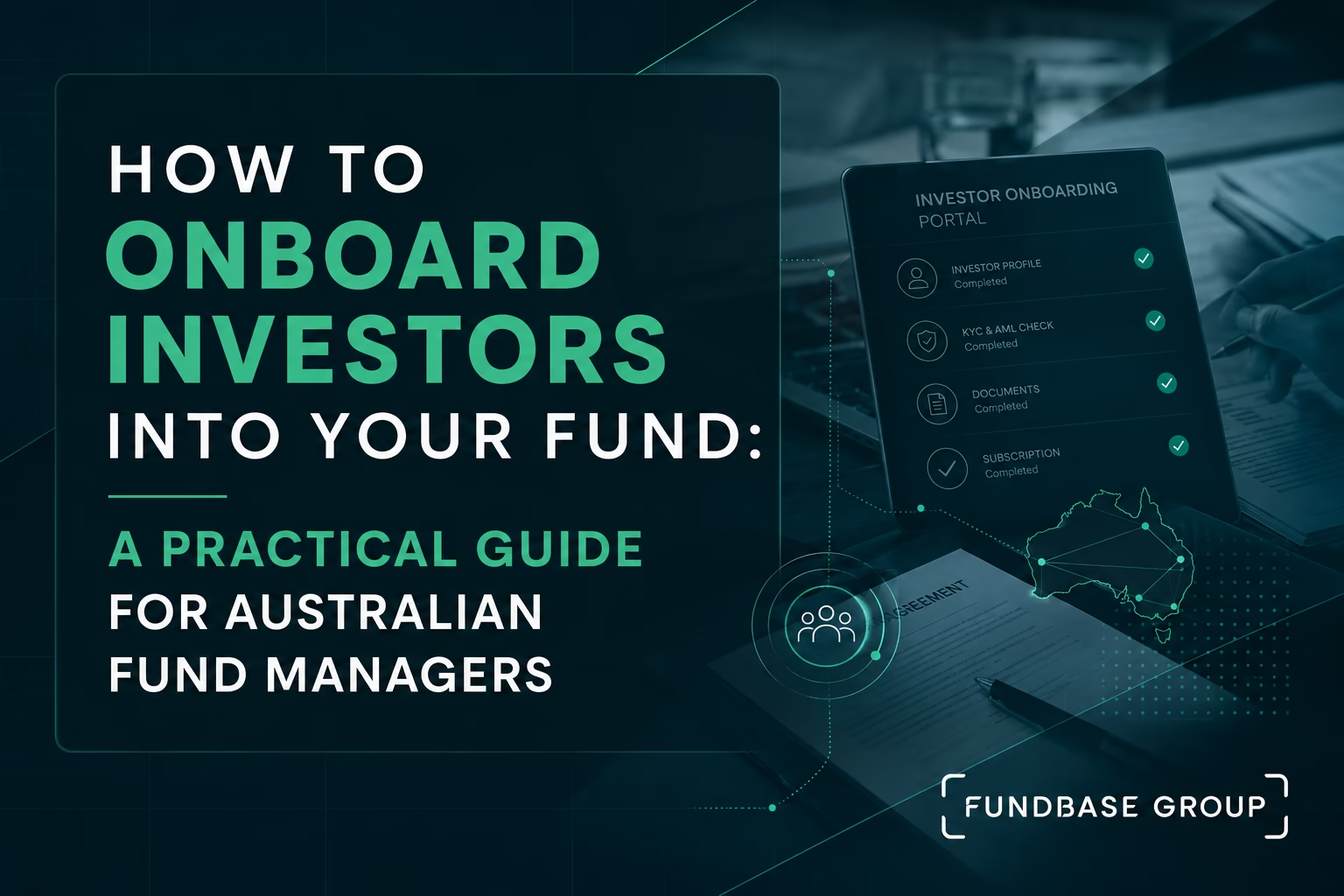
The First Thing Your Investor Actually Experiences
An investor who backs your fund has likely spent weeks — sometimes months — evaluating your strategy, track record, fees, and team. After all of that, the very first operational experience they have with your fund is onboarding.
That is not a back-office detail. It is the moment the investor decides whether the fund they have just committed to is as well-run as it presented itself to be.
For many Australian fund managers, especially those in early growth stages, onboarding is where operational shortcomings first become visible. Paper-based forms, repeated document requests, unexplained delays and no communication from the compliance team — these things do not go unnoticed.
The Numbers Tell a Clear Story
Industry data on investor onboarding makes uncomfortable reading for fund managers who have not invested seriously in this area.
According to research published by Fenergo in October 2025, 70% of financial institutions — including asset managers and fund administrators — lost clients in the past year due to slow onboarding processes. That figure has climbed steadily from 67% in 2024 and 48% in 2023. Across the industry, average client onboarding abandonment rates now sit at approximately 10%.
Separate analysis from B4 Finance (2025) found that up to 40% of professional investors still face administrative or regulatory obstacles that delay their subscription. That means two out of every five investors you are asking to commit capital are hitting a wall before they are even properly in the door.
For fund managers competing for capital in Australia's institutional and wholesale market — where operational due diligence is now standard — these numbers have a direct commercial consequence. An investor who abandons an onboarding process does not typically return.
What Typically Goes Wrong
Most onboarding failures come down to one of three root causes: poor process design, insufficient technology, or fragmented service providers who do not communicate with each other. These often appear together.
Document collection is disorganised
Investors are asked for the same information multiple times because different teams — compliance, registry, legal — are each running their own checklists independently. The investor experiences this as a lack of coordination. From their perspective, the fund does not appear to have its act together.
KYC and AML/CTF checks are treated as last-minute tasks
When identity verification and AML/CTF compliance checks are not built into the onboarding workflow from the beginning, they create a bottleneck near closing. The fund manager then chases documents under pressure, the investor experience deteriorates, and the legal or financial close is delayed.
Communication goes silent
Once documents are submitted, investors often hear nothing. No confirmation, no timeline, no progress update. In the absence of communication, investors tend to assume something has gone wrong — even when the process is proceeding normally. Silence in an investor relationship sets a poor precedent.
Manual processes introduce errors
Data entered by hand across multiple systems creates inconsistencies. An incorrect address in the registry, a mismatched entity name in a compliance system — these errors compound over time and become expensive to identify and correct. They also create audit risk.
The process does not account for entity complexity
Many wholesale investors — family offices, self-managed superannuation funds, corporate entities and trusts — have layered ownership structures that require additional KYB (Know Your Business) documentation and beneficial ownership verification. A process designed for individual investors will fail them at the first step.
What Good Investor Onboarding Actually Looks Like
Getting investor onboarding right does not necessarily require a large team or a significant technology budget. It requires a clear process, the right digital tools, and a provider model that does not create gaps between functions.
Set expectations before the process begins
Before a new investor submits a single document, they should know exactly what is required, in what format, and within what timeframe. An onboarding communication — ideally delivered through a digital portal — that sets out the full checklist removes the back-and-forth that accounts for most delays.
This step also signals operational maturity. An investor who receives a clear, professional onboarding brief during the process starts from a different impression of your fund than one who receives a poorly worded email asking for a list of documents with no context or instrictions.
Build compliance into the workflow — not on top of it
KYC and AML/CTF obligations under Australia's Anti-Money Laundering and Counter-Terrorism Financing Act 2006 apply from the moment a subscription is received. AUSTRAC expects fund managers and their administrators to have documented customer identification procedures and risk assessment processes embedded in the onboarding workflow.
In practice, this means:
- Collecting identification documents and information during the application process, not as a separate follow-up
- Completing beneficial ownership verification for corporate and trust structures as part of the initial application
- Running sanctions screening and politically exposed person (PEP) checks before subscription proceeds are accepted
- Documenting the risk assessment for each investor so that ongoing monitoring has a proper baseline
When these steps sit inside the digital application — rather than handled manually by a compliance team operating on a different system — the process is both faster and more defensible to a regulator.
Use a digital platform that investors can actually navigate
Paper-based subscription documents remain common in the Australian market, particularly among smaller fund administrators. For investors who have experienced digital onboarding elsewhere — whether through larger fund administrators, financial services platforms, or everyday financial products — the contrast is shocking.
A well-designed digital investor application should:
- Guide the investor through the process step by step, prompting only for information relevant to their specific investor type
- Allow document uploads directly within the application, with format guidance
- Support electronic signatures where appropriate
- Provide real-time confirmation of receipt and a clear indication of what happens next
The FundBase Group platform supports digital applications, KYC/KYB verification and AML/CTF processing as part of a single, integrated onboarding workflow. Investors complete everything in one place rather than navigating between separate systems.
Keep the investor informed throughout
An investor who submitted their documents three days ago and has heard nothing is already having a poor experience — regardless of whether the fund manager's team is doing everything correctly. The experience is defined by what the investor perceives, not by what is happening internally.
Best practice is to build status updates into the onboarding process itself: confirmation when documents are received, a notification when compliance review is underway, and clear communication if anything additional is required.
Get the registry right from day one
The investor registry is the foundation for every subsequent operation: distributions, unit price communications, tax statements, capital calls and regulatory reporting. Data entered incorrectly at onboarding cascades through these functions for the life of the investor relationship.
This means treating the registry entry as a quality-controlled step — not an afterthought once compliance is done. Every entity name, ABN, TFN, address and contact detail should be verified against the application documents before the investor is confirmed in the registry.
Separate registry and administration systems are a known source of data inconsistency. An integrated model — where onboarding data flows directly into the registry without manual re-entry — removes this risk and reduces the ongoing cost of data management.
Provide ongoing access through an investor portal
The onboarding process does not end when the subscription is confirmed. An investor who gains access to a well-designed portal immediately after onboarding receives a strong early signal that the fund is set up to communicate clearly and consistently.
An investor portal should give investors direct access to:
- Holding information
- Distribution statements and annual tax documents
- Fund reports and performance commentary
- Contact details and the ability to update their own information
Institutional and sophisticated investors treat the quality of investor reporting and portal access as a governance indicator. Poor access to fund information after onboarding is one of the more common sources of investor dissatisfaction reported in fund administration reviews.
The ASIC and AUSTRAC Dimension
Australian fund managers operating managed investment schemes are subject to both ASIC oversight and AUSTRAC's AML/CTF regime. Getting investor onboarding right is not only a service quality issue — it is a regulatory obligation with real consequences for non-compliance.
Under the AML/CTF Act, fund administrators and trustee/responsible entities providing designated services must:
- Verify customer identity before providing the designated service
- Conduct enhanced due diligence for higher-risk customers
- Maintain documented records of all customer identification procedures
- Report suspicious matters to AUSTRAC
Australia's AML/CTF reform program — which has been extending obligations to additional professional and financial service categories — means the documentation and process standard expected from fund managers and their administrators is rising. Fund managers who depend on manual, undocumented onboarding processes carry growing exposure. See our article on AML/CTF Tranche 2 obligations for a detailed breakdown of what the recent reforms mean in practice.
A fund administrator with embedded compliance expertise and documented processes — rather than one that passes compliance questions to a separate external consultant — is the appropriate model for fund managers who want to manage this exposure seriously.
Why Fragmented Providers Create Onboarding Problems
Many fund managers in Australia manage investor onboarding across multiple separate providers: a registry service in one place, a compliance consultant on retainer elsewhere, and a technology platform added separately. Each provider is responsible for their own piece of the process. None is responsible for the whole.
This is where investors encounter the repeated document requests and unexplained delays described earlier. The registry needs identification documents. The compliance team needs the same documents for its KYC file. Nobody is sharing data. The investor is asked three times for the same things and receives no explanation as to why.
Fragmented delivery also creates fragmented accountability. When something goes wrong — a missed AML check, a registry error, a delayed subscription confirmation — it is genuinely unclear which provider owns the problem. Coordination takes time that should be spent on the investor relationship.
The model that removes this is an integrated one. When investor onboarding, AML/KYC, registry and investor reporting sit within a single platform delivered by a single provider, the handoffs disappear, data stays consistent, and there is one clear point of contact when something needs attention. That is what the FundBase Group model is designed to deliver.
How FundBase Group Approaches Investor Onboarding
FundBase Group's investor onboarding and registry services are built as an integrated part of its broader fund administration offering — not as an add-on to a separate compliance or administration system.
The model covers:
- Digital applications — investors complete their application and compliance documentation in one place, through a guided digital workflow that adapts to their investor type
- KYC/KYB and AML/CTF processing — identity verification, beneficial ownership checks and risk assessment are conducted and documented as part of the onboarding process, meeting AUSTRAC requirements
- Registry management — investor data flows from the application directly into a managed registry, maintained to support all downstream administration and reporting functions without manual re-entry
- Investor portal access — investors gain access to an investor portal after onboarding is confirmed, providing ongoing access to fund documents, performance data and distribution information
- Compliance integration — because FundBase Group also provides AFSL and compliance support, the onboarding process sits within a broader compliance framework rather than operating in isolation from it
For managers using the Fund-in-a-Box service, this infrastructure is built into the fund launch package. Registry, onboarding and compliance are ready from day one — not assembled after launch as the manager discovers what is missing.
The difference between FundBase Group and a fragmented collection of providers is not primarily about technology features. It is about whether there is a single point of accountability for the investor's experience — and whether the data generated at onboarding is consistent and usable across the fund's entire operating infrastructure.
A Practical Checklist for Reviewing Your Onboarding Process
Whether you are launching a new fund or reviewing an existing operation, these questions are worth working through:
- Speed: How long does it take to complete investor onboarding from application to confirmed subscription? Is that timeline consistent?
- Document duplication: Are investors asked for the same documents more than once? If so, which provider or process step is causing the duplication?
- Compliance integration: Are KYC, KYB and AML/CTF checks embedded in the application workflow, or are they a separate step run by a different team on a different system?
- Registry accuracy: Is onboarding data verified and entered directly into the registry, or manually re-keyed from compliance records?
- Communication: Do investors receive status updates throughout the process, or do they need to follow up to find out what is happening?
- Post-onboarding access: What does the investor experience look like after their subscription is confirmed? Do they have immediate portal access?
- Accountability: If something goes wrong in the onboarding process, which provider owns the problem?
If the answer to more than one or two of these questions reveals a gap, the issue is likely structural — not something that individual process improvements will resolve.
The Practical Path Forward
For Australian fund managers looking to raise and retain capital in a market where investor expectations are rising, the quality of the onboarding experience matters more than most managers acknowledge.
Onboarding is where the investor relationship begins in practice, rather than on paper. A process that is slow, disorganised or non-compliant sets a tone that is difficult to reverse. A process that is clear, fast and professionally managed starts the relationship correctly — and makes everything that follows easier.
The FundBase Group platform is designed to deliver that standard as part of an integrated fund administration model — covering digital investor onboarding, AML/KYC compliance, registry, and investor reporting, without requiring the fund manager to coordinate with multiple providers independently.
If you are reviewing your investor onboarding process or building one from scratch as part of a new fund launch, speak to the FundBase Group team.
References
- Backbase. Client onboarding: The hidden profit engine wealth firms can't ignore. https://www.backbase.com/blog/client-onboarding-the-hidden-profit-engine-wealth-firms-cant-ignore
- B4 Finance. 2025 guide to digital investor onboarding. https://www.b4finance.com/blog/digital-investor-onboarding-the-2025-guide-for-investment-funds
- Fenergo. Global financial institutions struggle with rising client losses and compliance costs as AI adoption increases. https://resources.fenergo.com/newsroom/global-financial-institutions-struggle-with-rising-client-losses-and-compliance-costs-as-ai-adoption-increases-fenergo
- Fintech Global. 70% of banks lose clients due to slow onboarding. https://fintech.global/2025/10/08/70-of-banks-lose-clients-due-to-slow-onboarding/

Ready to launch
Get in touch with our team to discuss your fund management needs.